
Find Massachusetts Criminal Court Records
Massachusetts criminal court records are held by the Trial Court system across all 14 counties. You can search for criminal cases through the MassCourts portal, request a CORI background check, or visit a clerk's office in person. The state splits criminal cases between Superior Courts for serious felonies and District Courts for misdemeanors and less serious charges. Each county has its own courts and clerk staff who handle records requests. Whether you need a docket sheet, a case disposition, or a full criminal history, this guide shows you where to look and what to expect in Massachusetts.
Massachusetts Criminal Court Records Overview
How to Search Massachusetts Criminal Court Records Online
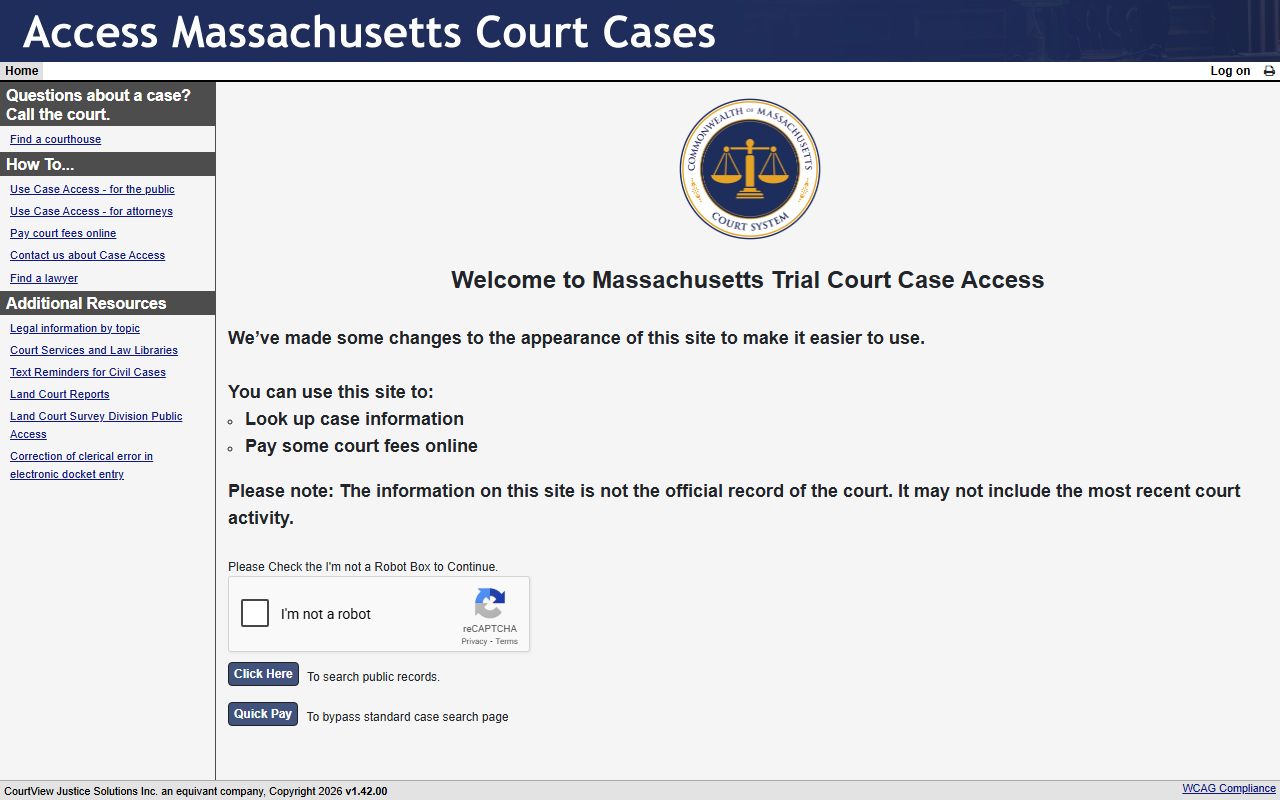
MassCourts is the main way to look up criminal court records in Massachusetts. It is free and open to anyone. The system covers all 14 counties and lets you pull up docket info for cases in Superior Court, District Court, and Boston Municipal Court. You can find it at masscourts.org.
There is one big catch with criminal cases. Most criminal records on MassCourts are only searchable by docket number, not by name. Name searches work well for civil cases but are limited for criminal ones. If you know the case number, you can look up the full docket sheet with charges, hearing dates, and dispositions. The case number format varies by court type. A Superior Court criminal case looks like 1681CR02072. A District Court case looks like 1153CR000005. You need the right format with correct spacing and leading zeros.
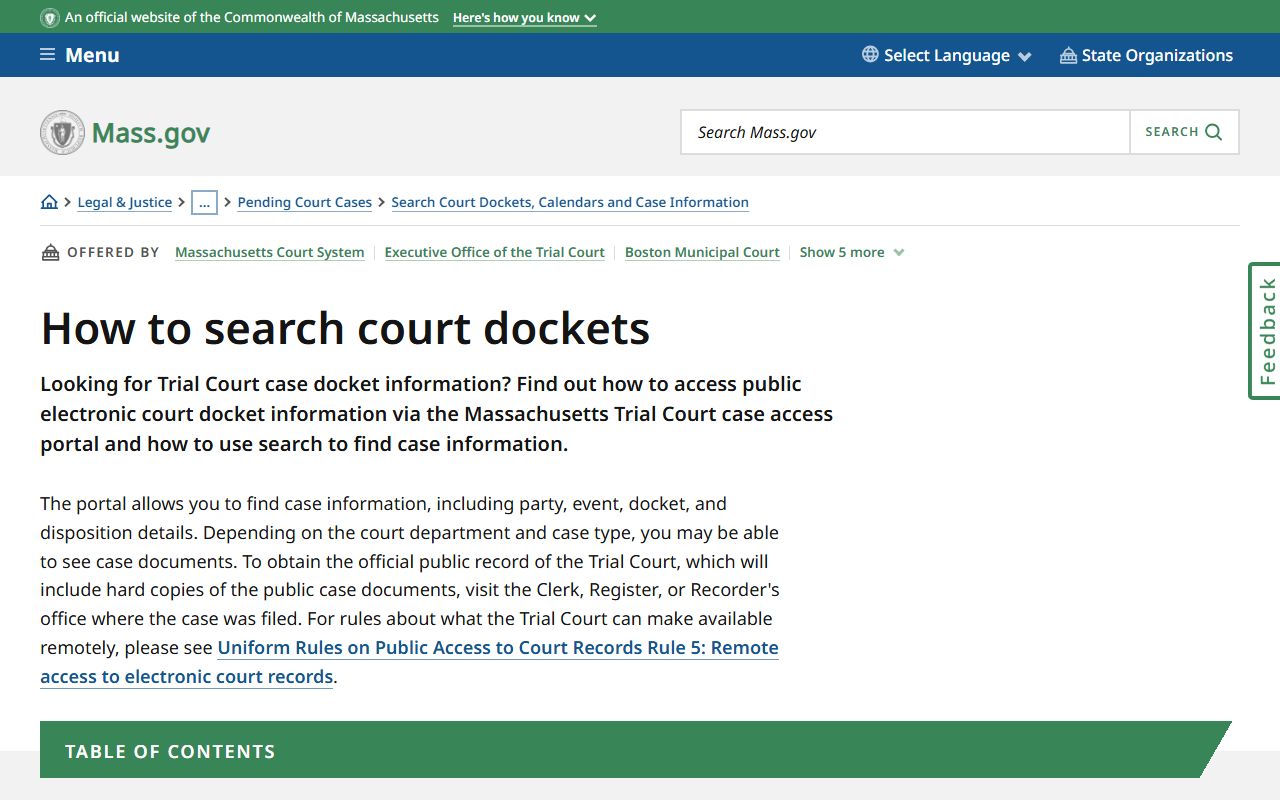
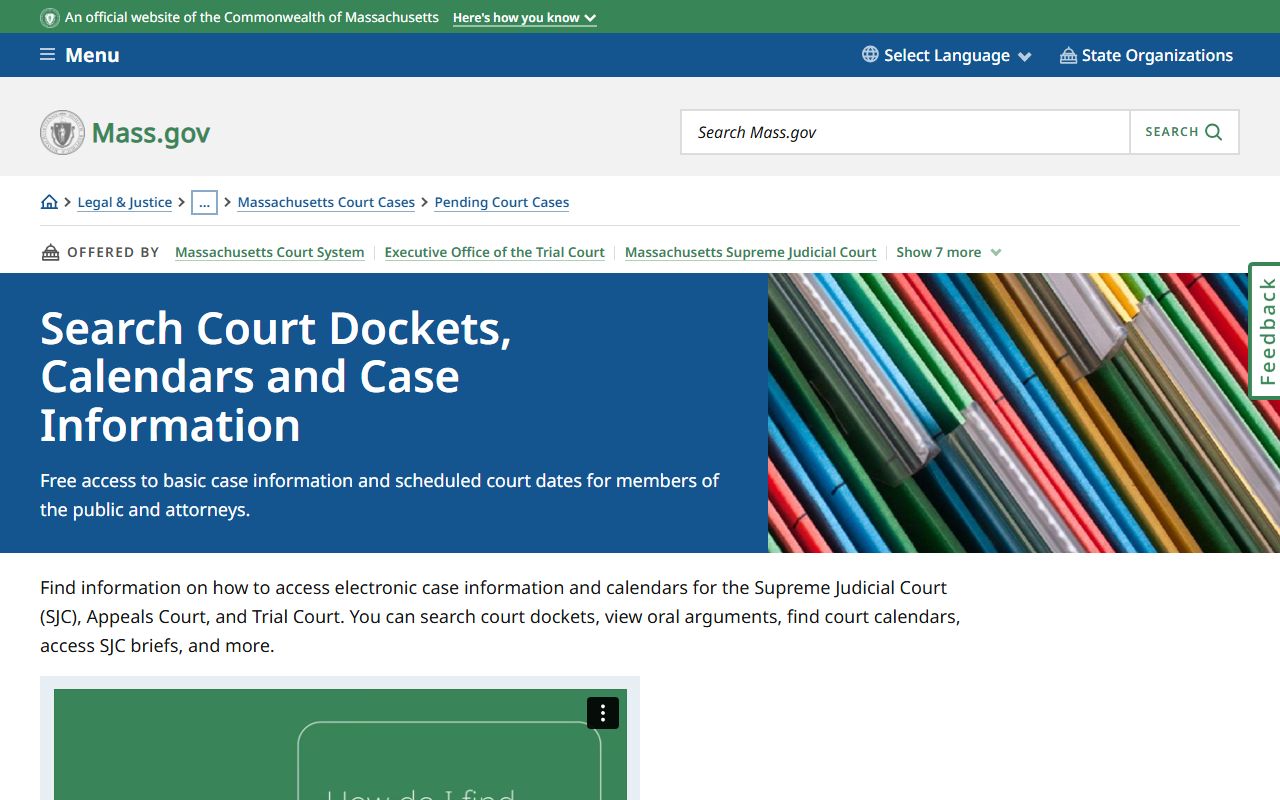
The Massachusetts Trial Court put together a guide on how to search court dockets online. You can read the full instructions at mass.gov.
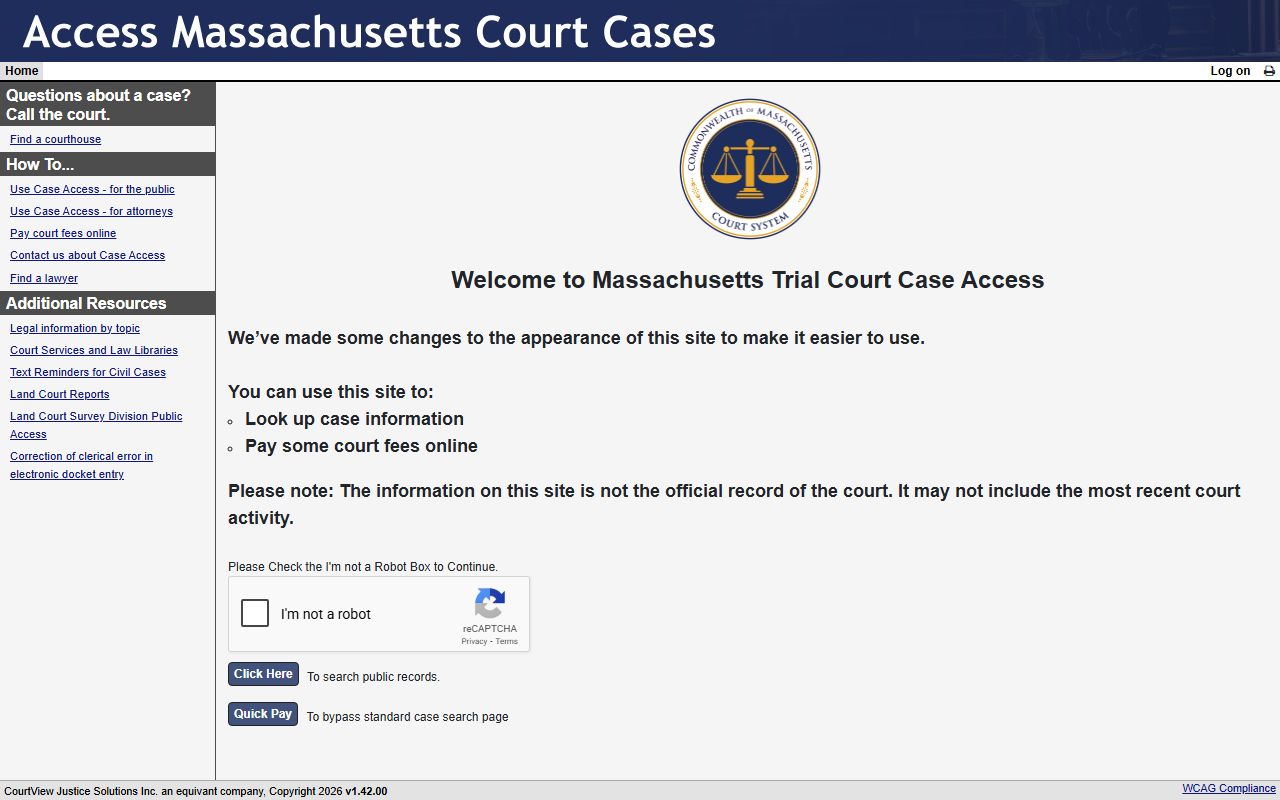
To start a search, go to the MassCourts portal. Check the CAPTCHA box. Click the link to search public records. Then pick the court department, division, and location. For criminal cases, you will need to select the right court type. The search court dockets guide on mass.gov walks you through each step.
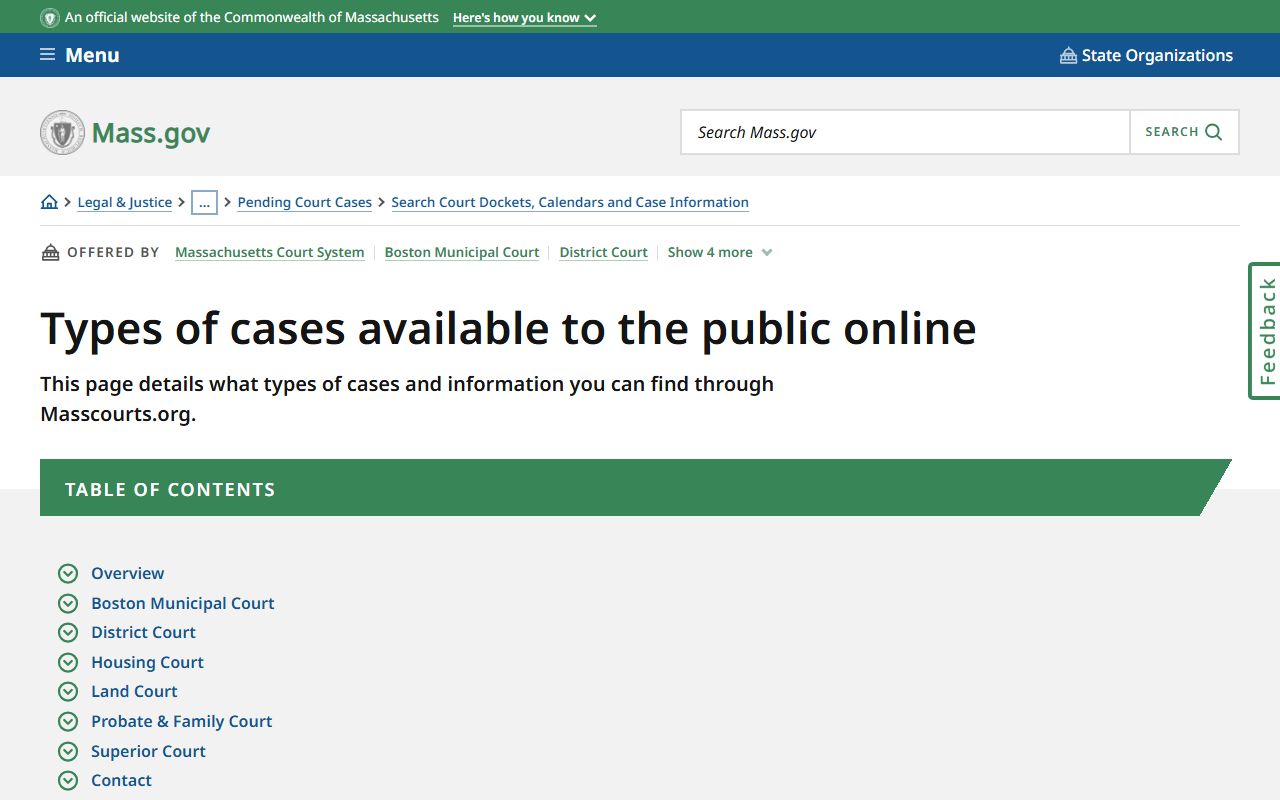
Not all case types show up online. The state has a list of what is available to the public through MassCourts. Check the available case types page to see what you can and cannot find. Sealed records, juvenile cases, and impounded files will not appear in the system.
Massachusetts Criminal Background Checks (CORI)
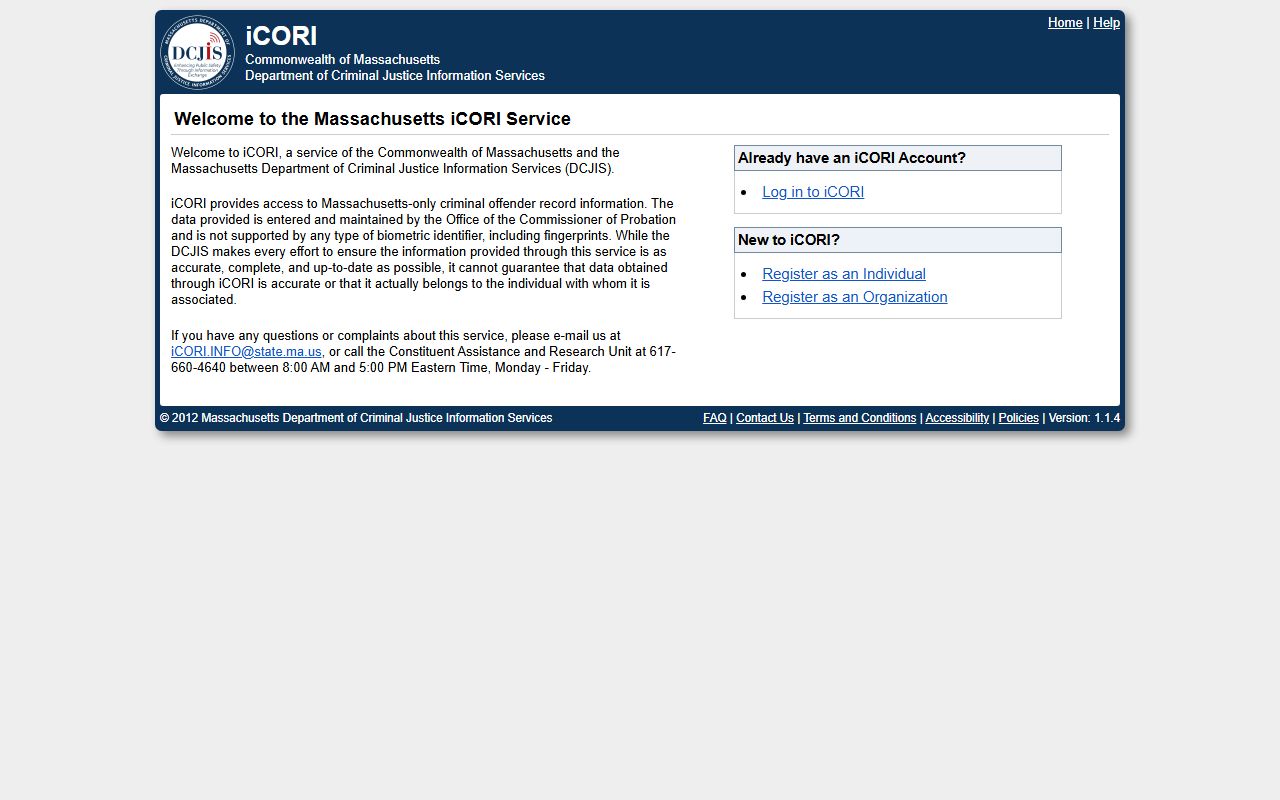
The CORI system is separate from court docket searches. CORI stands for Criminal Offender Record Information. The Department of Criminal Justice Information Services (DCJIS) runs it from their office at 200 Arlington Street, Suite 2200, Chelsea, MA 02150. You can reach them at (617) 660-4600 or visit mass.gov/dcjis.
A CORI check gives you a person's criminal history across all Massachusetts courts. It pulls together arrests, charges, convictions, and dispositions into one report. The general public can get a limited version for $25 per request. Employers and housing providers who register with DCJIS can get a more detailed standard CORI. Law enforcement has full access. You need the person's full name, date of birth, Social Security number, and a government-issued photo ID to make a request.
You can run a CORI check online through the iCORI system at icori.chs.state.ma.us. One nice thing: every person in Massachusetts can get one free copy of their own CORI per year. After that first free check, self-requests also cost $25.
The criminal records topic page on mass.gov has more details on CORI access levels, how to dispute errors on your record, and how to request sealing or expungement.
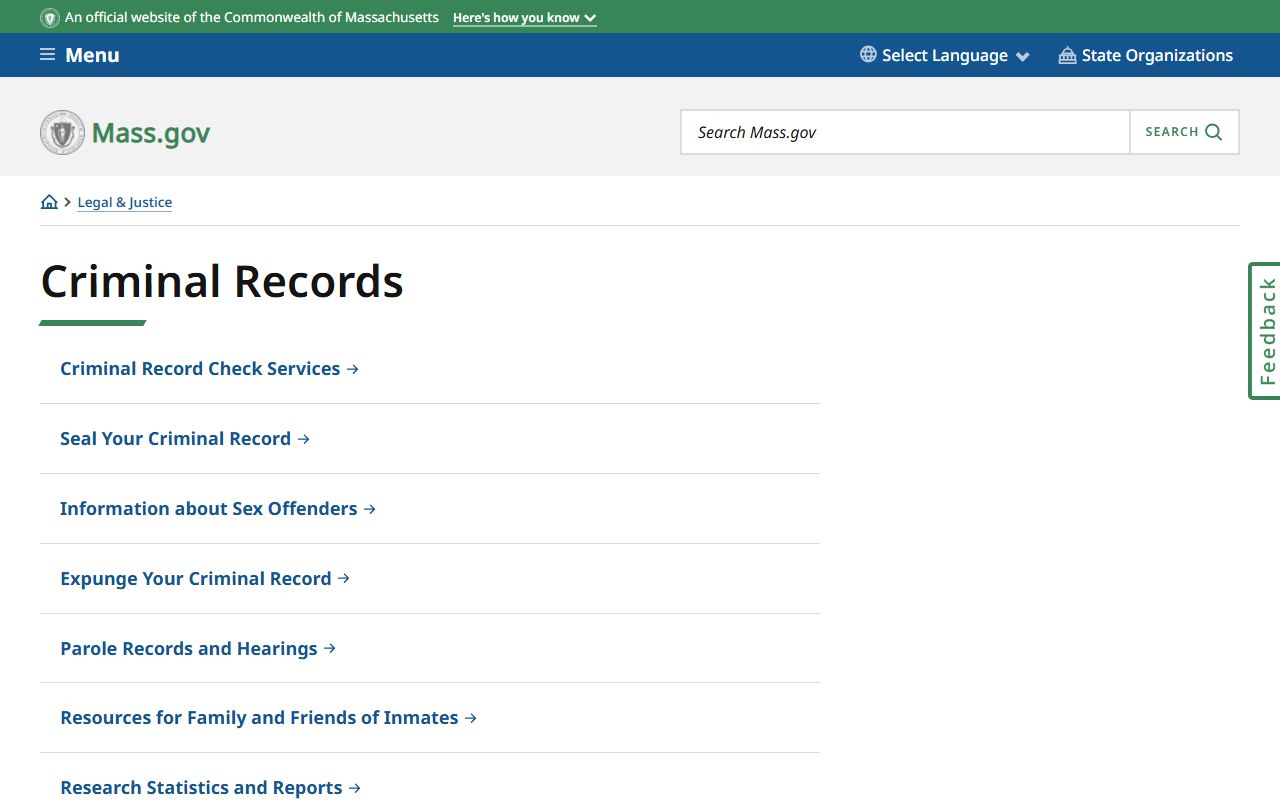
Note: A CORI check and a court docket search are two different things. CORI gives you a criminal history summary. A docket search gives you detailed case records from a specific court.
Massachusetts Criminal Court System
Massachusetts splits criminal cases between two main court levels. Superior Court handles serious felonies like murder, armed robbery, and major drug cases. These are cases where the potential sentence is more than two and a half years in state prison. District Courts handle misdemeanors and lesser felonies. Boston has its own special court called the Boston Municipal Court (BMC) that handles both criminal and civil matters within city limits.
Each of the 14 counties has at least one Superior Court. Most counties also have several District Courts spread across their cities and towns. Middlesex County, for example, has two Superior Court locations plus 11 District Courts. Smaller counties like Nantucket have just one of each, both in the same building. Criminal records from both court levels show up on MassCourts, but you need to search the right court and location to find what you want.
The Massachusetts Trial Court oversees all of these courts. Their main phone number is (617) 878-0100. You can find court locations and contact details at mass.gov/courts. If you need help with the MassCourts online system, email eAccess@jud.state.ma.us for tech support.
What Massachusetts Criminal Court Records Show
A criminal docket sheet is the main document you get from a court records search. It shows everything that happened in a case from start to finish. The header shows the court name, county, and case number. Party info includes the defendant's full name, date of birth, last known address, and their attorney. The prosecuting District Attorney's office is also listed.
Charge info is a big part of the record. Each charge lists the formal offense, the statute it falls under (like M.G.L. c. 265, § 13A for assault and battery), and whether it is a felony or misdemeanor. The date of the alleged offense is there too. Then you get the chronological docket entries. These show every event in the case: when the complaint was filed, the arraignment date and plea, bail amounts, motions filed, hearing dates, trial dates, the verdict, and sentencing details.
How long courts keep these records depends on the case. Superior Court keeps felony records resulting in incarceration permanently. First-degree murder cases are kept forever too. Other felonies stay on file for 25 years after the final disposition. Misdemeanors are kept for 10 years. District Courts have similar rules, with felonies kept for 20 years and misdemeanors for 10 years after disposition.
Older records may be stored in the Massachusetts Archives at 220 Morrissey Boulevard, Boston, MA 02125. Call (617) 727-2816 to check on historical criminal court records.
How to Get Criminal Court Records in Massachusetts
You can get copies of criminal court records in person, by mail, or sometimes by email. In-person requests are the fastest option. Go to the clerk's office at the right court, fill out a request form, show your photo ID, and pay the fees. Simple requests can be filled the same day. Complex or old records may take 5 to 10 business days.
For mail requests, send a written letter to the clerk's office. Include the case name or defendant's name, the docket number if you have it, the date range, and what documents you need. Add a copy of your photo ID and a self-addressed stamped envelope. Pay by check or money order. Mail requests take about 2 to 3 weeks.
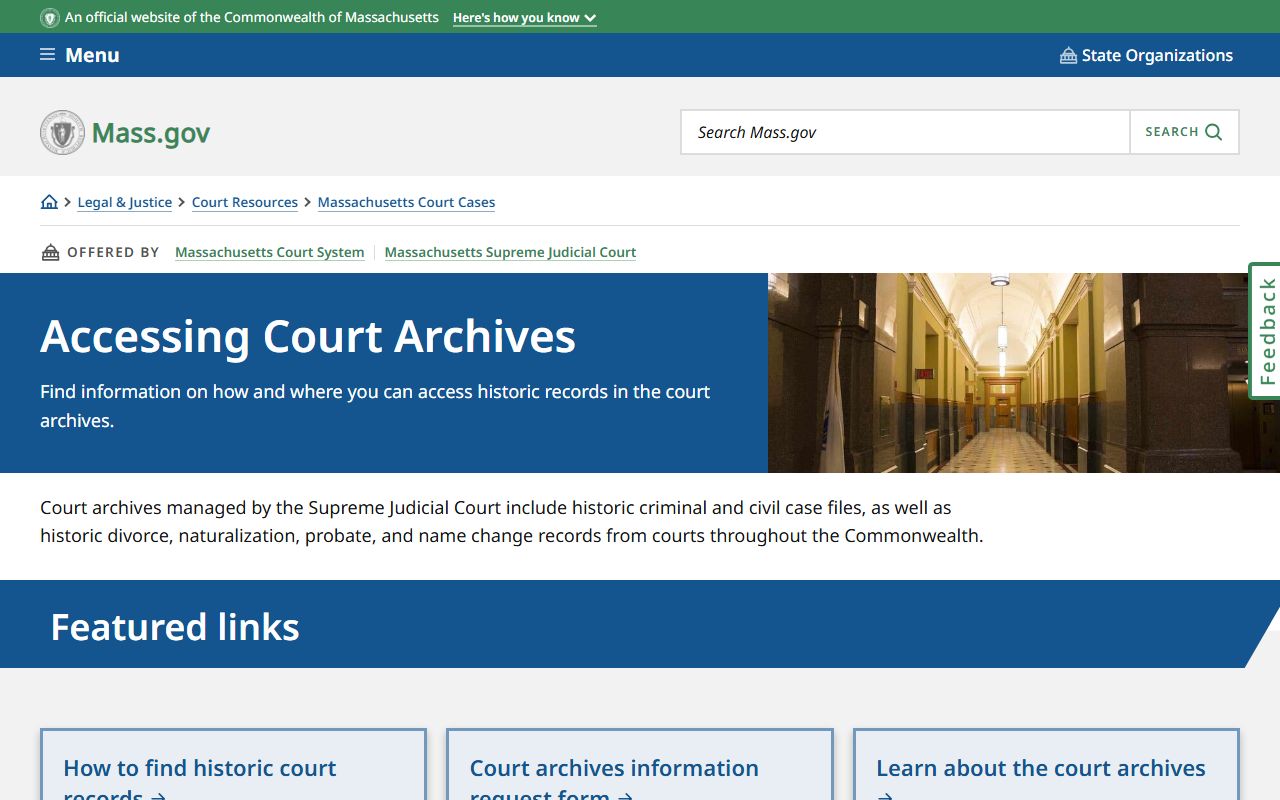
Massachusetts court archives hold older records that may not be at the courthouse anymore. The accessing court archives page on mass.gov explains how to request records that have been moved to storage.
Massachusetts Criminal Court Records Fees
Court copy fees are set by the state and apply in all 14 counties. Unattested copies cost just $0.05 per page. Attested copies run $2.50 per page. If you need a certified copy of a judgment, order, or decree, that is $20.00 per document. A transcript of judgment costs $50.00. Staff-assisted record searches cost $5.00 to $20.00 depending on the court.
Courts take cash (in-person only), personal checks, attorney's checks, money orders, certified checks, cashier's checks, and credit cards at most locations. If you cannot afford the fees, you can ask for a waiver. File an Affidavit of Indigency with the court clerk. The judge will review it and decide if you qualify for free copies.
CORI background checks cost $25 per request. Remember, you get one free self-check each year.
Sealing and Expungement of Criminal Records
Massachusetts law lets people seal or expunge certain criminal records. These are two different things. Sealing hides a record from most public searches but does not destroy it. Expungement actually removes the record.
Under M.G.L. c. 276, § 100A, you can ask to seal a criminal conviction. Misdemeanors become eligible 3 years after the disposition. Felonies take 7 years. If your case was dismissed or you were found not guilty, you can petition to seal it right away under M.G.L. c. 276, § 100C. The expungement rules are in M.G.L. c. 276, §§ 100E through 100U, but expungement is only for certain cases and has stricter requirements.
Juvenile criminal records have extra protections. Under M.G.L. c. 119, § 60A, juvenile records are confidential and not available to the general public. They do not show up on MassCourts or in standard CORI checks.
Are Criminal Court Records Public in Massachusetts
Yes. Most criminal court records are public in Massachusetts. The state's public records law under M.G.L. c. 66, § 10 gives the public a right to access government records, and Trial Court Rule XIV sets the rules for accessing court files specifically. You do not have to be involved in the case or give a reason for your request.
Some records have limits. Sealed and impounded cases are not available. Juvenile records are confidential. Cases involving grand jury proceedings may be restricted. Records involving certain victims (like sexual assault cases) might have parts redacted to protect the victim. But for the vast majority of criminal cases in Massachusetts, the docket sheet and case file are open to anyone who asks.
Browse Criminal Court Records by County
Each county in Massachusetts has its own Superior Court and District Courts that handle criminal cases. Pick a county below to find local court info, fees, and resources.
Criminal Court Records in Major Cities
Residents of larger cities file criminal cases at their local District Court or the county Superior Court. Pick a city to find court locations and contact details.